AI

Artificial Intelligence, WIPO

WIPO Launches Artificial Intelligence Infrastructure Interchange

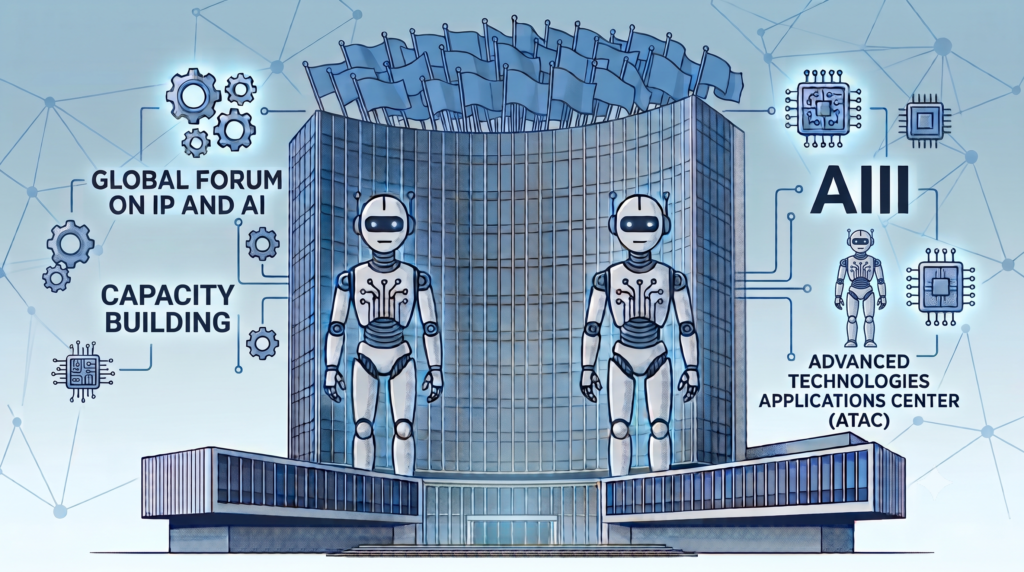
WIPO launched its Artificial Intelligence Infrastructure Interchange (AIII) on March 17, which was described as having the goal of supporting the development of AI technology that supports the livelihoods of creators and innovators. The goal has two aspects – making AI tools available to creators to help their work, while at the same time assuring that the works used to create such tools support the moral and material rights of authors.  The key focus is on “infrastructure” that can technically identify AI creations and promote models for creators to use AI as a tool. Assistant Director General Ken Natsume explained that “the answer lies in various tools: Watermarks, metadata, digital ID, authentication tools, digital distribution frameworks.” The AIII’s launch page similarly defines the “IP infrastructure” of its focus as composed of “watermarks, authentication tools, standards, metadata, digital identifiers, rights management and content recognition systems, and digital distribution frameworks … developed by rightsholders and creators to build new business models that safeguard their rights.”  This definition of AI infrastructure is quite different than the broader sense embraced by Public AI advocates. That approach proposes “treating AI as public infrastructure, emphasising democratic governance, broad accessibility, and accountability to the communities that AI systems serve.” The concept of “Just AI” used by the Centre on Knowledge Governance and others is largely congruent with the goals of Public AI, but also raises additional human rights concerns, including the moral and material interests of creators. In this sense, the WIPO AIII focus on tools to enable remuneration and creator opt outs in AI Tools can be seen as promoting some but not all aspects of a Just AI vision.  At the launch event, participants described the goal of AIII as providing a neutral forum for creators, rights holders, developers, and experts to share information on the development and use of such tools, including tools that can be used in the creation process. Music and voice or actor simulation models are a core focus of the project. These are areas where AI tools have the potential to create content that competes with the works used to train them. In such areas, the justification for using highly licensed tools and giving creators maximum ability to opt out of their content being used in training is at its apex.    The WIPO project has created a “Technical exchange network (TEN)” where technical experts from the private sector, including academics and civil society, will share information on the development and use of content identification tools. There will also be an annual public meeting of the project and a government expert group that will share information with policy makers about such infrastructure and exchange on national developments.

Artificial Intelligence, Blog

The Moratorium the AI Industry Cannot Afford to Lose

The WTO’s 14th Ministerial Conference (MC14) starts in Yaoundé, Cameroon, next week with a packed agenda and real stakes. Buried in the long list of negotiations is a decision that will have a significant impact beyond trade: whether to renew the moratorium on non-violation complaints under the TRIPS Agreement. The outcome will help determine whether the TRIPS flexibilities and exceptions, particularly copyright exceptions, which have recently become the backbone of the AI economy, can be challenged at the WTO. Two Moratoriums, One Bargain Since 1998, WTO members have supported a temporary moratorium on customs duties on electronic transmissions, including software downloads, streamed content, and digital services. That moratorium has been extended at every Ministerial Conference since. It is up for renewal again at MC14, where the United States (US) is pushing to make it permanent. The moratorium originated at the 1998 WTO Ministerial in Geneva, where members adopted a Work Program on E-commerce and committed to “continue their current practice of not imposing customs duties on electronic transmissions” (WTO 1998). Critically, the term “electronic transmissions” was never defined. That ambiguity allowed the scope of the moratorium to expand alongside the digital economy, covering an ever-wider range of digital content and services without any fresh multilateral agreement. Since then, the US has been embedding the moratorium in its bilateral free trade agreements. The US-Jordan FTA in 2000 was the first agreement to include a binding commitment not to impose customs duties on electronic transmissions. Recent agreements on reciprocal trade (ARTs) go further and require countries to support multilateral adoption of a permanent moratorium on customs duties on electronic transmissions at the WTO. All these efforts build a web of bilateral obligations that formalize the current push for a permanent multilateral moratorium at MC14. Less discussed but just as consequential is a second moratorium: the freeze on non-violation and situation complaints under the TRIPS Agreement. The moratorium on the TRIPS non-violation and situation complaints (NVC) has also been extended at each Ministerial Conference since 1995.  Under TRIPS Article 64, a WTO member can file a non-violation complaint even when no TRIPS rule has been broken, claiming only that expected benefits have been “nullified or impaired” by another member’s measures. Non-violation claims create a significant IP weapon: they mean that a country’s copyright exceptions, fair use, limitations for research and education, patentability requirements, and compulsory licenses could, in principle, be challenged at the WTO not for violating TRIPS but for frustrating the commercial expectations of foreign rightsholders.  Any TRIPS measure that allegedly nullifies or impairs benefits under TRIPS may, under certain conditions, be challenged through a non-violation complaint (e.g., on the theory that it frustrates a member’s legitimate expectations). In principle, this creates a pathway to challenge a wide range of legitimate public-interest policies that affect rightsholders. Such policies could include, among others, rules on patentability, compulsory licensing, and copyright limitations and exceptions, including the US fair use doctrine. US copyright law includes a variety of specific exceptions, but fair use is the oldest and the most broadly applicable of all US exceptions to copyright infringement. As IP scholar Frederick Abbott warned as early as 2003, “non-violation causes of action could be used to threaten developing Members’ use of flexibilities inherent in the TRIPS Agreement and intellectual property law more generally. Thus, for example, Members that adopt relatively generous fair use rules in the fields of copyright or trademark might find that they are claimed against for depriving another.”  The two moratoriums have been traded as a package. Developing countries seeking the TRIPS NVC moratorium, which protects domestic policy space in health, access to knowledge, education, and technology transfer, have had to support the e-commerce moratorium, which benefits US digital platforms. Each Ministerial Conference is, in effect, another round of that exchange. If the e-commerce moratorium becomes permanent at MC14, as the US proposes, the key question is what developing countries receive in return, particularly on the TRIPS NVC side. Significance of Copyright Exceptions Many key internet functions rely on copyright limitations and exceptions. Search engines cache and index content without negotiating individual licensing agreements; search previews display short snippets; CDNs buffer and transmit protected works; cloud services store user-uploaded copyrighted files.  According to the CCIA’s 2025 report, fair use industries now account for 18 percent of US GDP, $4.9 trillion in value added, and $10.2 trillion in revenues in 2023, employing one in seven American workers. Within that broader figure, AI-related fair use industries alone generated $1.7 trillion in revenues in 2023, up 78 percent since 2017. The AI industry has added a new dimension. Training large language models requires access to vast quantities of text, books, articles, web pages, and code repositories. Much of that access has been broadly justified under fair use, which is transformative and serves a new purpose. In that sense, AI companies and the broader data economy are the newest dependents on copyright exceptions. If those limitations and exceptions can be challenged through non-violation complaints at the WTO, bypassing the question of whether they infringe TRIPS, the legal foundation for AI training could become globally contestable.  The Buenos Aires Lesson At the Buenos Aires Ministerial Conference in December 2017, during Donald Trump’s first term, the renewal of both moratoria on the e-commerce and TRIPS NVC was uncertain. Both moratoria were eventually extended. That Buenos Aires episode revealed, or at least made visible, that the fair use and safe harbor exceptions underpinning internet commerce were potentially vulnerable to non-violation challenges. There was a growing awareness among US tech industry stakeholders of how much the TRIPS NVC moratorium mattered to their legal operating environment. The two moratoriums were treated as a package. That understanding should be stronger today. AI companies are actively navigating copyright litigation in domestic courts, whose outcomes are still unresolved. Exposure via non-violation complaints at the WTO would add a second front. What was at stake in 2017 is now more visible and more significant. What’s Next The argument is pretty straightforward. If the US

Artificial Intelligence, Blog, Centre News

Centre Announces Short Course on Intellectual Property and Artificial Intelligence

The Centre on Knowledge Governance is pleased to announce a new short course on AI and IP to take place in Geneva from September 29-30, 2026. COURSE DESCRIPTION  This intensive two-day course provides a comprehensive, comparative analysis of the evolving legal and policy landscape at the intersection of Intellectual Property (IP) and Artificial Intelligence (AI). Participants will explore pressing legal challenges, including the copyright protection for AI training data, the patentability and copyright of AI-generated outputs, and the balance between proprietary interests and the public interest in research (Text and Data Mining and computational research) and the development of “Public AI.”  The course will feature in-depth comparative analysis of legal frameworks and policy proposals across the European Union (EU), United States (USA), India, Brazil, Singapore, Japan, and in international forums, such as the World Intellectual Property Organization, World Trade Organization and other agencies.  The learning experience will culminate in a practical role-play exercise in which students will draft a model international legal instrument aimed at ensuring fair remuneration for creators while safeguarding the rights of researchers and public interest organizations developing AI infrastructure. This legal instrument will focus on  a range of factors to be used in distinguishing research and public interest uses of AI from commercial competitive uses. LEARNING OBJECTIVES Upon completion of this course, participants will be able to: WHO IS THIS PROGRAMME FOR? This programme is particularly relevant for mid- to senior level practitioners from various organisations working at the intersection of intellectual property and AI policy or scholarship, such as: LECTURERS The Course will be directed by Sean Flynn and Ben Cashdan of the Centre on Knowledge Governance, Geneva Graduate Institute. Guest lecturers will participate in person or online to bring comparative expertise from jurisdictions such as India, Brazil and China and the African continent, in addition to the US and EU. SCHOLARSHIPS 10 scholarships will be available for highly motivated government delegates from developing countries or representatives of public interest organizations who participate in multilateral policy processes on copyright, AI and the rights of researchers. You can apply below: APPLICATION FOR COURSE To enroll for the course itself please use the online form on this page. If you have also applied for a scholarship please not this when you enroll. Thanks.

Africa: Copyright & Public Interest, Artificial Intelligence, TDM Cases

Case Studies of AI for Good and AI for Development

Today the Geneva Centre on Knowledge Governance presents a series of Case Studies on AI for Good in Africa and the Global South. These grew out of our work on Text and Data Mining and our policy work in support of the Right to Research. Researchers in the Global South are responding to local and global challenges from health and education to language preservation and mitigation of climate change. In all these case computational methods and Artificial Intelligence (AI) play a leading role in finding and implementing solutions. A common thread that runs through all the cases is how intellectual property laws can support innovation and problem solving in the public interest, whilst protecting the interests of creators, communities and custodians of traditional knowledge. In addition several practitioners are looking at how to redress data imbalances, where large companies in the Global North have much greater access to works, for historical, legal and economic reasons. The cases include: Each of our case studies in written up in the form of a report, combined with a video exploration of the case study in the words of its leading practitioners.

Blog

The AI Remuneration Debate: Three Perspectives

The rapid development of generative AI has sparked intense debate over how, or even if, creators should be compensated when their copyrighted works are used to train commercial AI systems. This issue pits the drive for technological innovation against the fundamental rights of authors to benefit from their creations, leading to diverse proposals for legal and economic frameworks that seek to strike a fair balance. The following three presentations from the Global Expert Network on Copyright User Rights Symposium in June 2025 explore this complex landscape from distinct legal, philosophical, and geopolitical perspectives. The Geneva Centre on Knowledge Governance and the Program on Information Justice and Intellectual Property bring you three contributions to the AI Remuneration Debate. PART 1: Christophe Geiger approaches the problem from a human rights perspective, arguing for a balance between the right to develop AI for cultural and scientific progress and the author’s right to benefit from their work. He critiques current systems, noting the “all-or-nothing” nature of the US “fair use” doctrine and the EU’s “bizarre” opt-out rule for text and data mining, which he believes fails to secure fair compensation for authors due to unequal bargaining power with publishers and producers. His central proposal is to replace the EU’s opt-out system with a mandatory statutory remuneration scheme for the commercial use of works in AI training. Drawing on the success of similar “remunerated exceptions” in Europe, which generate significant revenue, Geiger proposes that income from this scheme be distributed directly to creators. Geiger contends this model would uphold authors’ human right to fair remuneration without stifling innovation. PART 2: Zachary Cooper reframes the debate by arguing that traditional copyright concepts are becoming obsolete in an age of infinite digital remixing and AI-driven content creation. He contends that focusing on authorship thresholds is futile because the line between human and machine creation is hopelessly blurred and impossible to audit reliably. Methods like watermarking are technically weak and easily circumvented. For Cooper, the real issue is the massive scale of AI generation, which makes copyright enforcement impractical and weakens creators’ negotiating power. He describes copyright as “a dam in an infinite river,” an outdated barrier against a constant flow of transformation. Instead of rigid ownership rules, Cooper suggests the future lies in collective licensing models and a greater emphasis on attribution and visibility, which would allow creators to capture value as their work spreads across massive platforms. PART 3: Vitor Ido situates the remuneration debate within the political and economic context of Brazil and Latin America, presenting it as a crucial tool for regulating corporate power and protecting national creative industries. He explains that for GRULAC (Group of Latin American and Caribbean Countries), the issue is not just about copyright but about challenging the dominance of large, foreign-based platforms that exploit local content with little to no payment to creators. The discussion also encompasses cultural sovereignty, such as protecting the dubbing industry from AI-generated voices, and safeguarding the traditional knowledge of Indigenous communities from misappropriation. Ido highlights Brazil’s draft AI Bill, which proposes an inverse of the EU’s system: a mandatory remuneration right that includes a reciprocity clause and ties the payment amount to the size of the AI company, directly targeting the market power of major corporations. This approach frames remuneration as a strategic element in a broader agenda of economic justice and cultural preservation in the Global South.

Blog

Italy updates its copyright law to address AI

On September 18, 2025, the Italian Senate definitively approved the country’s first comprehensive framework law on artificial intelligence (AI). The new law also reflects Italy’s commitment to aligning its domestic legal system with the EU Artificial Intelligence Act (Regulation (EU) 2024/1689), ensuring coherence between national rules and the emerging European regulatory framework. Law no. 132 of September 23, 2025 (Provisions and delegations to the Government regarding artificial intelligence), has been published in the Official Gazette no. 223 of September 25, 2025, and it will enter into force on October 10, 2025. It consists of 6 chapters and 28 articles, not only establishing ethical and regulatory frameworks for AI across various sectors but also bringing several changes to the field of copyright law. In particular, Chapter IV, titled “Provisions for the Protection of Users and Copyright,” modifies Article 1 of Law No. 633/1941 (Italy’s Copyright Act) and introduces a new Article 70-septies, adapting the legal framework to the evolving challenges posed by AI-generated content and data mining. Emphasising human authorship The first major change introduced by Article 25,  a), of the new AI law is a revision to Article 1 of the Italian Copyright Act. The phrase “human” has been explicitly added, clarifying that only works of human creativity are eligible for protection under Italian copyright law. The amended text now reads: This law protects works of human creativity in the fields of literature, music, figurative arts, architecture, theatre, and cinematography, whatever the mode or form of expression, even when created with the assistance of artificial intelligence tools, provided they are the result of the author’s intellectual effort. This addition is not merely semantic. It codifies a crucial principle: while AI can be a tool in the creative process, copyright protection remains reserved for human-generated intellectual effort. This positions Italian law in alignment with the broader international trend, seen in the EU, U.S., and UK, of rejecting full legal authorship rights for non-human agents such as AI systems. In practice, this means that works solely generated by AI without significant human input will likely fall outside the scope of copyright protection. Regulating text and data mining for AI The second key innovation is provided by Article 25,  b), of the new AI law, which introduces Article 70-septies in the Italian Copyright Act, providing clarity on the legality of text and data mining (TDM) activities used in the training of AI models. The provision states: 1. Without prejudice to the provisions of the Berne Convention for the Protection of Literary and Artistic Works, reproductions and extractions from works or other materials available online or in databases to which one has lawful access, for the purposes of text and data mining by AI systems, including generative AI, are permitted in accordance with Articles 70-ter and 70-quater. This provision essentially reaffirms that text and data mining (TDM) is permitted under certain conditions, namely where access to the source materials is lawful and the activity complies with the existing TDM exceptions under EU copyright law, as already implemented in Articles 70-ter and 70-quater of the Italian Copyright Act. It mirrors the spirit of the EU Directive 2019/790 on Copyright in the Digital Single Market, which created specific exceptions for TDM, notably distinguishing between scientific and general uses. By formally reiterating the TDM exceptions for the use of AI, Italy seeks to balance the promotion of AI development with the protection of content creators’ rights. However, challenges remain regarding the definition of ‘lawful access’ and the ability of rightsholders to effectively exercise their opt-out rights in relation to TDM activities. Conclusion The recent amendments to Italy’s Copyright Act mark an important step toward harmonising traditional legal frameworks with the realities of emerging technologies, such as AI. By emphasising human authorship and providing clearer legal pathways for text and data mining, the new provisions aim to foster both innovation and respect for intellectual property. The law shall enter into force on the fifteenth day following its publication in the Official Gazette of the Italian Republic. This article was reposted from the original at https://communia-association.org/2025/10/01/italy-updates-its-copyright-law-to-address-ai/

Artificial Intelligence, Blog, Latin America / GRULAC

INTELIGENCIA ARTIFICIAL, DERECHOS DE AUTOR Y EL FUTURO DE LA CREATIVIDAD: APUNTES DE LA FERIA INTERNACIONAL DEL LIBRO DE PANAMÁ

Por Andrés Izquierdo Durante la segunda semana de agosto, fui invitado a hablar en la Feria Internacional del Libro de Panamá, un evento organizado por la la Oficina del Derecho de Autor de Panamá, el Ministerio de Cultura y la Asociación Panameña de Editores con apoyo de la Organización Mundial de la Propiedad Intelectual (OMPI). Mi presentación se centró en la cada vez más compleja intersección entre las leyes de derechos de autor y la inteligencia artificial (IA), un tema ahora en el centro del debate legal, cultural y económico mundial. Esta publicación resume los argumentos principales de esa presentación, basándose en litigios recientes, investigaciones académicas y desarrollos de políticas, incluyendo el informe de mayo de 2025 de la Oficina de Derechos de Autor de EE. UU. sobre IA generativa. ¿Cómo deberían responder las leyes de derechos de autor al uso generalizado de obras protegidas en el entrenamiento de sistemas de IA generativa? El análisis sugiere que hay debates emergentes en varias áreas clave: los límites del uso justo y las excepciones, la necesidad de derechos de remuneración aplicables, y el papel de la concesión de licencias y la supervisión regulatoria. El artículo se desarrolla en cinco partes: comienza con una visión general del contexto legal y tecnológico en torno al entrenamiento de IA; luego revisa propuestas académicas para recalibrar los marcos de derechos de autor; examina decisiones judiciales recientes que ponen a prueba los límites de la doctrina actual; resume el informe de 2025 de la Oficina de Derechos de Autor de EE. UU. como respuesta institucional; y concluye con cuatro consideraciones de política para la regulación futura. UN ESCENARIO LEGAL Y TECNOLÓGICO EN TRANSFORMACIÓNLa integración de la IA generativa en los ecosistemas creativos e informativos ha expuesto tensiones fundamentales en la ley de derechos de autor. Los sistemas actuales ingieren rutinariamente grandes volúmenes de obras protegidas —como libros, música, imágenes y periodismo— para entrenar modelos de IA. Esta práctica ha dado lugar a preguntas legales no resueltas: ¿Puede la ley de derechos de autor regular de manera significativa el uso de datos de entrenamiento? ¿Se extienden las doctrinas y disposiciones legales existentes—como el uso justo, o excepciones y limitaciones—a estas prácticas? ¿Qué remedios, si los hay, están disponibles para los titulares de derechos cuyas obras se utilizan sin consentimiento? Estas preguntas siguen abiertas en todas las jurisdicciones. Si bien algunos tribunales y agencias reguladoras han comenzado a responder, una parte sustancial del debate está siendo moldeada ahora por la investigación académica  jurídica y por los litigios, cada uno proponiendo marcos para conciliar el desarrollo de la IA con los compromisos normativos del derecho de autor. Las siguientes secciones examinan este panorama evolutivo, comenzando con propuestas académicas recientes. PERSPECTIVAS ACADÉMICAS: HACIA UN EQUILIBRIO RENOVADOAl revisar la literatura académica, han emergido varios temas claros. Primero, algunos autores concuerdan en que deben fortalecerse los derechos de remuneración para los autores. Geiger, Scalzini y Bossi sostienen que, para garantizar verdaderamente una compensación justa para los creadores en la era digital, especialmente a la luz de la IA generativa, la ley de derechos de autor de la Unión Europea debe ir más allá de las débiles protecciones contractuales y, en su lugar, implementar derechos de remuneración robustos e inalienables que garanticen ingresos directos y equitativos a autores e intérpretes como cuestión de derechos fundamentales. Segundo, varios académicos subrayan que la opacidad técnica de la IA generativa exige nuevos enfoques de remuneración para los autores. Cooper argumenta que, a medida que los sistemas de IA evolucionen, será casi imposible determinar si una obra fue generada por IA o si una obra protegida específica se utilizó en el entrenamiento. Advierte que esta pérdida de trazabilidad hace que los modelos de compensación basados en atribución sean inviables. En cambio, aboga por marcos alternativos para garantizar que los creadores reciban una compensación justa en una era de autoría algorítmica. Tercero, académicos como Pasquale y Sun sostienen que los responsables de formular políticas deberían adoptar un sistema dual de consentimiento y compensación: otorgar a los creadores el derecho a excluirse del entrenamiento de IA y establecer un gravamen sobre los proveedores de IA para asegurar el pago justo a aquellos cuyas obras se utilizan sin licencia. Gervais, por su parte, defiende que los creadores deberían recibir un nuevo derecho de remuneración, asignable, por el uso comercial de sistemas de IA generativa entrenados con sus obras protegidas por derechos de autor; este derecho complementaría, pero no reemplazaría, los derechos existentes relacionados con reproducción y adaptación. También hay un consenso creciente sobre la necesidad de modernizar las limitaciones y excepciones, en particular para educación e investigación. Flynn et al. muestran que una mayoría de los países del mundo no tienen excepciones que permitan la investigación y enseñanza modernas, como el uso académico de plataformas de enseñanza en línea. Y en Science, varios autores proponen armonizar las excepciones de derechos de autor internacionales y domésticas para autorizar explícitamente la minería de texto y datos (TDM) para investigación, permitiendo el acceso lícito y transfronterizo a materiales protegidos sin requerir licencias previas. En la OMPI, el Comité Permanente sobre Derecho de Autor y Derechos Conexos (SCCR) ha tomado medidas en este ámbito aprobando un programa de trabajo sobre limitaciones y excepciones, actualmente en discusión para el próximo SCCR 47. Y en el Comité de Desarrollo y Propiedad Intelectual (CDIP), está aprobado un Proyecto Piloto sobre TDM para Apoyar la Investigación e Innovación en Universidades y Otras Instituciones Orientadas a la Investigación en África – Propuesta del Grupo Africano (CDIP/30/9 REV). Mi propio trabajo, al igual que el de Díaz & Martínez, ha enfatizado la urgencia de actualizar las excepciones educativas latinoamericanas para dar cuenta de usos digitales y transfronterizos. Eleonora Rosati sostiene que el entrenamiento con IA no licenciada queda fuera de las excepciones de derechos de autor existentes en la UE y el Reino Unido, incluidas el Artículo 3 (TDM para investigación científica) de la Directiva DSM, el Artículo 4 (TDM general con exclusiones) y el Artículo 5(3)(a) de la Directiva InfoSoc (uso para enseñanza o investigación

Artificial Intelligence, Blog, Latin America / GRULAC

AI, Copyright, and the Future of Creativity: Notes from the Panama International Book Fair

AI, Copyright, and the Future of Creativity: Notes from the Panama International Book FairDuring the second week of August, I was invited to speak at the Panama International Book Fair, an event hosted by the World Intellectual Property Organization (WIPO), the Panama Copyright Office, the Ministry of Culture, and the Panama Publishers Association. My presentation focused on the increasingly complex intersection between copyright law and artificial intelligence (AI)—a topic now at the center of global legal, cultural, and economic debate. This post summarizes the core arguments of that presentation, drawing on recent litigation, academic research, and policy developments, including the U.S. Copyright Office’s May 2025 report on generative AI. How should copyright law respond to the widespread use of protected works in the training of generative AI systems? The analysis suggests there are emerging discussions around several key areas: the limits of fair use and exceptions, the need for enforceable remuneration rights, and the role of licensing and regulatory oversight. The article proceeds in five parts: it begins with an overview of the legal and technological context surrounding AI training; it then reviews academic proposals for recalibrating copyright frameworks; it examines recent court decisions that test the boundaries of current doctrine; it summarizes the U.S. Copyright Office’s 2025 report as an institutional response; and it concludes by outlining four policy considerations for future regulation. A Shifting Legal and Technological LandscapeThe integration of generative AI into creative and informational ecosystems has exposed foundational tensions in copyright law. Current systems routinely ingest large volumes of copyrighted works—such as books, music, images, and journalism—to train AI models. This practice has given rise to unresolved legal questions: Can copyright law meaningfully regulate the use of training data? Do existing doctrines and legal provisions—fair use, or exceptions and limitations—extend to these practices? What remedies, if any, are available to rightsholders whose works are used without consent? These questions remain open across jurisdictions. While some courts and regulatory agencies have begun to respond, a substantial part of the debate is now being shaped by legal scholarship and litigation, each proposing frameworks to reconcile AI development with copyright’s normative commitments. The following sections examine this evolving landscape, beginning with recent academic proposals. Academic Perspectives: Towards a New Equilibrium In reviewing the literature, several clear themes have emerged. First, some authors agree that remuneration rights for authors must be strengthened. Geiger, Scalzini, and Bossi argue that to truly ensure fair compensation for creators in the digital age, especially in light of generative AI, EU copyright law must move beyond weak contractual protections and instead implement strong, unwaivable remuneration rights that guarantee direct and equitable revenue flows to authors and performers as a matter of fundamental rights. Second, some scholars highlight that the technical opacity of generative AI demands new approaches to author remuneration. Cooper argues that as AI systems evolve, it will become nearly impossible to determine whether a work was AI-generated or whether a particular copyrighted work was used in training. He warns that this loss of traceability renders attribution-based compensation models unworkable. Instead, he calls for alternative frameworksto ensure creators are fairly compensated in an age of algorithmic authorship. Third, scholars like Pasquale and Sun argue that policymakers should adopt a dual system of consent and compensation—giving creators the right to opt out of AI training and establishing a levy on AI providers to ensure fair payment to those whose works are used without a license. Gervais, meanwhile, argues that creators should be granted a new, assignable right of remuneration for the commercial use of generative AI systems trained on their copyrighted works—complementing, but not replacing, existing rights related to reproduction and adaptation. There is also a growing consensus on the need to modernize limitations and exceptions, particularly for education and research. Flynn et al. show that a majority of the countries in the world do not have exceptions that enable modern research and teaching, such as academic uses of online teaching platforms. And in Science, several authors propose harmonizing international and domestic copyright exceptions to explicitly authorize text and data mining (TDM) for research, enabling lawful, cross-border access to copyrighted materials without requiring prior licensing.  At WIPO, the Standing Committee on Copyright and Related Rights (SCCR) has been taking steps in this area by approving a work program on L&E´s, under current discussions for the upcoming SCCR 47. And in the Committee on Development and Intellectual Property (CDIP), there is a Pilot Project approved on TDM to Support Research and Innovation in Universities and Other Research-Oriented Institutions in Africa – Proposal by the African Group (CDIP/30/9 REV). My own work, as well as that of Díaz & Martínez, has emphasized the urgency of updating Latin American educational exceptions to account for digital and cross-border uses.  Eleonora Rosati argues that unlicensed AI training falls outside existing EU and UK copyright exceptions, including Article 3 of the DSM Directive (TDM for scientific research), Article 4 (general TDM with opt-outs), and Article 5(3)(a) of the InfoSoc Directive (use for teaching or scientific research). She finds that exceptions for research, education, or fair use-style defenses do not apply to the full scope of AI training activities. As a result, she concludes that a licensing framework is legally necessary and ultimately unavoidable, even when training is carried out for non-commercial or educational purposes. Finally, policy experts like James Love warn that “one-size-fits-all” regulation risks sidelining the medical and research breakthroughs promised by artificial intelligence. The danger lies in treating all training data as equivalent—conflating pop songs with protein sequences, or movie scripts with clinical trial data. Legislation that imposes blanket consent or licensing obligations, without distinguishing between commercial entertainment and publicly funded scientific knowledge, risks chilling socially valuable uses of AI. Intellectual property law for AI must be smartly differentiated, not simplistically uniform. Litigation as a Site of Doctrinal Testing U.S. courts have become a key venue for testing the boundaries of copyright in the age of artificial intelligence. In the past two years, a growing number of cases

Blog

Ethical Data Scraping for Research – Expert Workshop held in Amsterdam

A unique, expert-led workshop on ethical data scraping was organized by Professor Niva Elkin-Koren and Dr. Maayan Perel and hosted by the Shamgar Center of Digital Law and Innovation, Tel Aviv University. The workshop was made possible by the generous support of the Right to Research in International Copyright Law coalition at the American University, especially Professor Sean Flynn, the Director of the Program on Information Justice and Intellectual Property (PIJIP). An interdisciplinary group of information law experts gathered in Amsterdam’s beautiful Volks hotel on July 2, 2025, to discuss data scraping for research and innovation and its ethical boundaries. The event aligned with the agenda of the Standing Committee on Copyright and Related Rights (SCCR), which promotes public interest strategies, coordinated action, and research, and seeks to inform public policy on legal exceptions and limitations for researchers. Data scraping is an essential research tool for academics and scientists across a wide range of disciplines. It is also critical for training artificial intelligence (AI) models and developing innovative research methodologies. The legal boundaries of data scraping attract considerable attention, not only from academics but also from policymakers, governments, courts, technology companies, and data providers worldwide. The boundaries of ethical data scraping— often dependent on the type of data being scraped, the technologies being used, the purpose of scraping, and the applicable legal framework—remain unclear. Consequently, researchers are left to navigate the potential legal risks and changing technological barriers set by tech giants, such as Cloudflare (recently adopting a permission-based approach to data scraping). As a result, researchers may be deterred from engaging in lawful data scraping, at the cost of not engaging in research that can serve the public interest. Moderated by Dr. Maayan Perel and Professor Eldar Haber, the workshop aimed to bring greater clarity to what ethical data scraping is and should be. The workshop applied practical and technical insights from real-world data scraping, analyzed the legal implications of various transatlantic approaches, and proposed guidelines for promoting ethical data scraping for research and development. To obtain a better understanding of how data scraping models work in practice, participants explored a test case model from Bright Data, an international data scraping company, whose model was also discussed in recent litigation with X and Meta. In a stimulating presentation, Bright Data representatives described their publicly available data scraping technology, elaborated on their ethical policies, and presented their “data for good” initiative, which offers scraping opportunities for researchers as well as other stakeholders. To encourage a productive dialogue between academic and business participants, the discussion followed a “red teaming” approach. Red teaming, a concept we adapted from the cybersecurity realm, essentially aims to help organizations proactively identify weaknesses and strengthen their security posture before actual attacks occur. Applying red-teaming’s critical approach, the participants identified potential legal challenges in Bright Data’s data test case model from various perspectives, including intellectual property law, competition law, privacy law, and data protection law, while also identifying points of legal tension between the US and the EU frameworks. The issues highlighted included the legal application of copyright law to information copying and storage; questions of competition law arising from the dominant market actors’ ability to adjust behavior and match prices; and the scope of privacy protection in personal information that data providers voluntarily make publicly accessible.   Next, insights from Bright Data’s test case were used to draw broader observations about what constitutes ethical data scraping in practice, especially for AI training. Key issues included: The workshop concluded with a broader discussion of potential legal, technical, and institutional strategies to promote ethical data scraping for academic research and technological development. Participants identified the need to distinguish between questions of access to data and questions of the use of the data, as each raises different legal issues. Key suggestions included: Participants: Tanya Aplin, Mor Avisar, Balazs Bodo, Sharon Bar Ziv, Sean Flynn, Eldar Haber, Uri Hacohen, Bernt Hugenholtz, Aline Iramina, Matthias Leistner, Dana Mazia, Maayan Perel, Mando Rachovista, Pamela Samuelson, Martin Senftleben, Ben Sobel, Streffan Verhultz, Amit Zac

Scroll to Top